How Does Page Speed Affect E-commerce Conversions? The Data You Can't Ignore
A 1-second delay cuts conversions by 7%. Discover how page speed directly impacts ecommerce revenue, with real case studies from Walmart, Vodafone, and more.
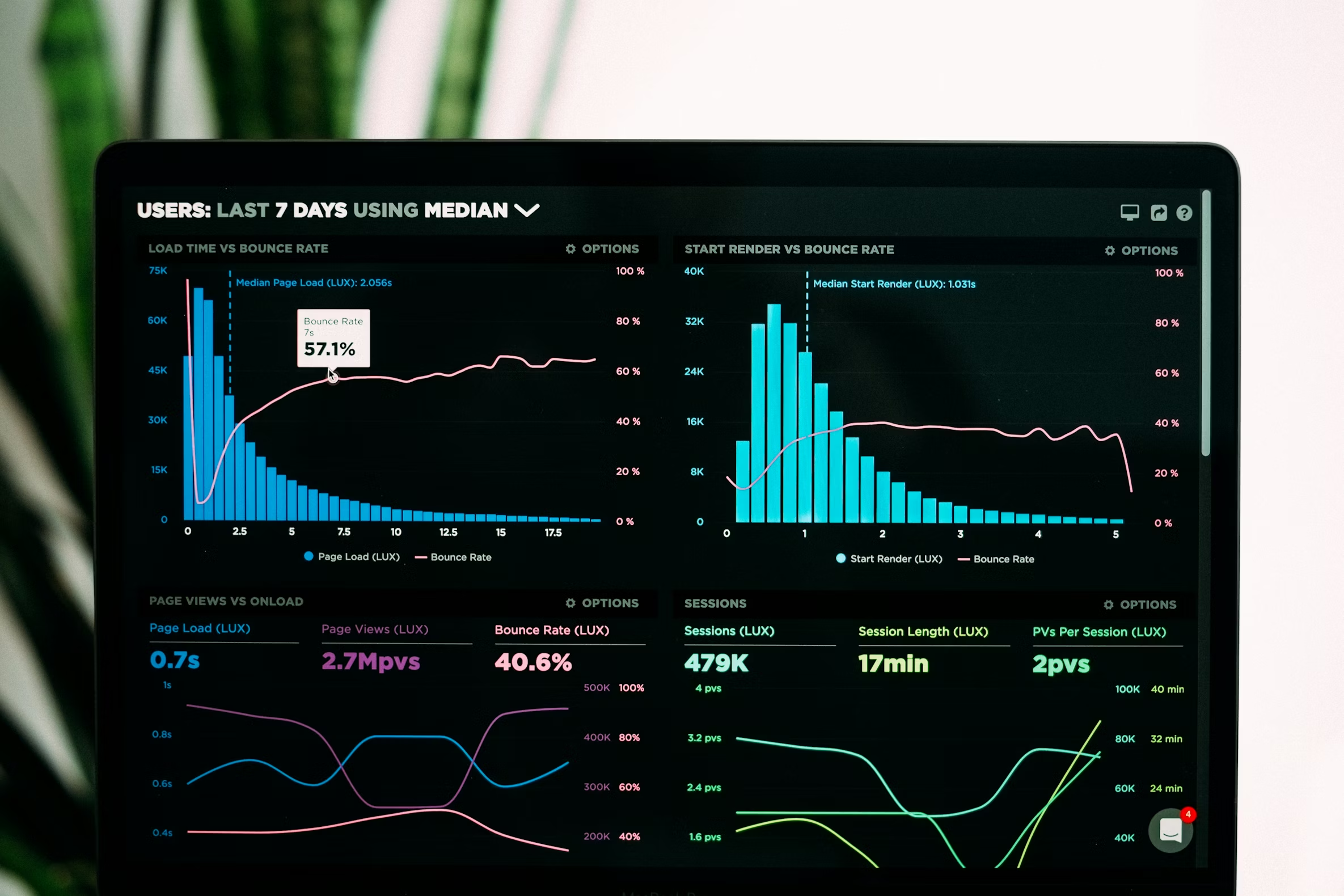
How Does Page Speed Affect E-commerce Conversions? The Data You Can't Ignore
Every millisecond your store takes to load is costing you money. That's not a scare tactic — it's measurable fact. Amazon famously calculated that every 100ms of latency shaved 1% off their sales. For a company doing billions in annual revenue, that's a staggering number. But smaller stores aren't immune. The same user psychology that makes Amazon shoppers impatient will drive your customers to a competitor the moment your product page stalls.
So what's the actual relationship between page speed and ecommerce conversions? And more importantly, what can you do about it? This guide breaks down the data, the business impact, and the technical levers you can pull — starting today.
[INTERNAL-LINK: what is conversion rate optimization → pillar page on CRO fundamentals]
Key Takeaways
A 1-second delay in mobile load time reduces conversions by approximately 7% (Google/Deloitte).
Sites loading in 1 second convert at 3× the rate of sites taking 5 seconds (Cloudflare).
Vodafone increased sales 8% by improving LCP 31%; Rakuten saw 33% more conversions after Core Web Vitals optimization.
Only 39% of ecommerce sites pass all three Core Web Vitals — a significant competitive gap (HTTPArchive, 2025).
A 0.1-second improvement in speed increases retail conversions by 8.4% on mobile.
Why Is Page Speed the Ecommerce Conversion Rate's Biggest Hidden Lever?
Speed isn't just a UX preference — it's revenue infrastructure. According to a joint study by Google and Deloitte, every 0.1 seconds of improvement in site load speed increases retail conversions by 8% and travel conversions by 10%. Those aren't estimates modeled on hypothetical traffic. They're observed outcomes from sites with millions of monthly visitors.
The numbers get starker when you look at abandonment. Fifty-three percent of mobile users abandon a site that takes more than 3 seconds to display content (Google). That means if your store loads in 4 seconds on mobile — which, given the average unoptimized mobile load time of 8.6 seconds, is actually decent — you've already lost more than half your mobile audience before they've seen a single product.

What makes this especially painful is that nearly 70% of all ecommerce traffic now comes from mobile devices (Hostinger). And mobile pages load an average of 87.8% slower than desktop. You're sending the majority of your traffic through your slowest channel. The compounding effect on revenue is enormous.
There's also a psychological dimension most store owners miss. Speed signals trust. A sluggish site tells shoppers — subconsciously, but immediately — that the brand isn't invested in their experience. Around 70% of shoppers have said page speed directly affects their willingness to buy from an online retailer (NitroPack, 2025). Your load time is part of your brand.
[INTERNAL-LINK: mobile commerce optimization guide → article on mobile UX for ecommerce]
What Does the Research Say About Load Time and Conversion Rate?
The relationship between speed and conversion isn't linear — it's exponential as you move into the slow zone. Sites loading in 1 second convert at a rate 5 times higher than those taking 10 seconds (NitroPack). Between the 1-second and 3-second marks, conversion rates drop from as high as 40% down to around 29% for ecommerce pages.
Bounce rate tells a similar story. When mobile load time goes from 1 to 3 seconds, bounce rate increases by 32%. From 1 to 5 seconds, it jumps 90%. At 6 seconds? Two out of three shoppers leave. If your analytics show high bounce rates and you haven't investigated load time yet, you've been looking in the wrong place.
One figure that should concern every store owner: the average unoptimized product detail page (PDP) takes 6.1 seconds to load. PDPs and category pages make up 72% of all page views during a shopper's journey. That's your most-visited real estate sitting at load times that drive away a majority of mobile users.
A citation worth memorizing: According to Cloudflare, sites loading in 1 second convert at 3× the rate of sites loading in 5 seconds — and every 100ms delay reduces conversion by approximately 7%, independent of any other variable on the page.
[INTERNAL-LINK: how to reduce bounce rate → article on landing page optimization and UX]
Real Companies, Real Revenue: Page Speed Case Studies That Prove the ROI
Statistics are powerful. But nothing builds the business case for speed investment like documented outcomes from real stores. These aren't cherry-picked anomalies — they represent a consistent pattern across industries and geographies.

Walmart found that every 1-second improvement in load time delivered a 2% increase in conversions. Every 100ms improvement added up to 1% more revenue. For a retailer at Walmart's scale, that compounds into billions. But the ratio applies at every scale — a store doing $500K annually would see a $10,000 lift from that same 1-second improvement.
Vodafone reduced its LCP (Largest Contentful Paint) by 31% and recorded an 8% increase in sales, an 11% improvement in cart-to-visit rate, and a 15% improvement in lead-to-visit rate. This wasn't a redesign. It was a performance optimization project.
Rakuten ran a controlled A/B test after improving its Core Web Vitals. The results were striking: a 53.4% increase in revenue per visitor, a 33.1% increase in conversion rate, and a 35.1% reduction in exit rate. Their average order value also rose 15.2%.
Zitmaxx Wonen, a Dutch furniture retailer, cut typical load times to 3 seconds and saw conversions jump 50.2%. Mobile revenue climbed 98.7%.
Furnspace reduced its image payload by 86%, cutting load time by 65%, and doubled its ecommerce purchase conversion ratio.
The pattern is undeniable. Performance investment is one of the highest-ROI technical projects available to an ecommerce team. According to a SpeedSense case study, a 7.6% sitewide conversion improvement translated to roughly a $6 million annual revenue lift, with mobile transactions up nearly 30%.
According to a 2025 joint report by Google and Deloitte, a 0.1-second improvement in load speed can increase retail conversions by 8.4% — an ROI that most paid acquisition channels can't match. This makes page speed optimization one of the most financially defensible technical investments in ecommerce.
How Do Core Web Vitals Connect to Conversion Rate and SEO Rankings?
Google's Core Web Vitals aren't just an SEO checklist item. They're a proxy for the exact friction that causes shoppers to abandon. LCP (Largest Contentful Paint) measures how quickly your hero product image appears. INP (Interaction to Next Paint) tracks how fast the page responds when someone taps "Add to Cart." CLS (Cumulative Layout Shift) captures whether buttons jump around as the page loads — a common cause of accidental taps and shopper frustration.
The ecommerce pass rate is sobering. HTTPArchive data from 2025 shows that only 39% of ecommerce sites pass all three Core Web Vitals simultaneously — three points below the global average of 42%. The reason is structural: a typical category page loads 20–60 product images, runs JavaScript for dynamic filters, fires remarketing and analytics scripts, and connects to real-time inventory systems. Every one of those elements competes for bandwidth during initial page load.
What this means in practice: your competitors are probably failing Core Web Vitals too. That gap represents an opportunity. Pages ranking at position 1 in search results are 10% more likely to pass Core Web Vitals than pages at position 9. Google has confirmed that when content quality is otherwise equivalent, the faster site wins the ranking.
There's also an emerging metric worth tracking: Google's 2025 addition, Engagement Reliability (ER), measures how consistently users can interact with your site — whether buttons, forms, and cart elements work reliably across all devices and network conditions. It's the difference between a page that appears loaded and one that's actually usable.
How Does Mobile Page Speed Specifically Impact Ecommerce Revenue?
Mobile is where the speed problem is most acute — and most expensive. The average webpage loads 87.8% slower on mobile than on desktop. Mobile accounts for around 70% of ecommerce traffic globally. Mobile cart abandonment sits between 75–85%, significantly above the already-painful 70.19% global average (Baymard Institute, 2025).

Decreasing mobile page load time by 1 second improves conversion rates by 5.9% and decreases bounce rate by nearly 9% (NitroPack). A 0.1-second improvement in mobile speed increases retail conversions by 8.4% and adds 9.1% more shoppers to basket. For a store processing 1,000 orders a month from mobile, that's potentially 84 additional sales from a sub-100ms improvement.
The math on lost revenue is equally striking. Take a store with 50,000 daily visitors, a 3.5% conversion rate, and a $50 average order value. Current load time: 6 seconds. If you improve load time by 1 second, the conversion rate rises to approximately 3.7%. Daily orders jump from 1,750 to 1,850. Daily revenue increases from $87,500 to $92,500. Annualized, that 1-second improvement is worth roughly $1.8 million. Get the site to Google's recommended 3-second mobile threshold, and the annual gain climbs to approximately $5.5 million.
Google uses mobile-first indexing, which means your mobile Core Web Vitals scores determine your search rankings — not your desktop scores. Optimizing for mobile isn't optional.
According to Google's Think with Google research, 53% of mobile users abandon a site that takes more than 3 seconds to display content — and the global average mobile load time remains well above that threshold. This creates a persistent revenue drain for stores that haven't prioritized mobile performance.
What Are the Most Effective Page Speed Optimizations for Ecommerce?
Knowing the problem is one thing. Fixing it efficiently is another. The good news: most ecommerce speed issues come from a small set of recurring culprits — unoptimized images, bloated JavaScript, no CDN, and slow server response times. Addressing these doesn't require a full platform rebuild.
Image optimization is the single biggest win for most ecommerce stores. Furnspace reduced its image payload by 86% and cut load time by 65% — doubling conversion rate in the process. Use modern formats like WebP or AVIF, serve correctly sized images per device, and implement lazy loading for below-the-fold product images.
CDN (Content Delivery Network) implementation routes your assets through servers geographically close to each shopper. It's particularly impactful for stores with international customers and is one of the most cost-effective infrastructure changes available.
JavaScript minimization and deferral matters because JavaScript is often the main culprit behind slow INP scores. Audit your third-party scripts — analytics, chat widgets, review tools, remarketing pixels — and defer or remove anything that doesn't need to load before first user interaction.
Server-side caching dramatically reduces Time to First Byte (TTFB), which sets the ceiling for everything else that loads. WordPress sites on shared hosting frequently fail Core Web Vitals primarily due to poor server response times and lack of edge caching. Managed hosting with edge CDN built in solves most of this.
Lazy loading for below-the-fold images means the browser doesn't fetch images the shopper hasn't scrolled to yet — keeping initial payload light and LCP fast.
The infrastructure cost of a Core Web Vitals optimization project typically ranges from $3,000 to $15,000 for implementation. If the monthly revenue lift from the improvement is $5,000–$10,000, the investment pays back in 1–3 months (ighenatt.es, 2026).
Get a Free Speed Audit Not sure where your store stands? Run your URL through Google PageSpeed Insights for a free baseline report, or consider a full Core Web Vitals audit to identify your highest-impact optimizations. Even a 1-second improvement can mean thousands of additional orders per year.
Frequently Asked Questions
How much does a 1-second delay in page load time cost in conversions?
A 1-second delay in mobile load time reduces conversions by approximately 7% (Google/Deloitte). For a store generating $10 million in annual sales, that single second of delay costs around $400,000 per year in lost revenue — before accounting for the SEO ranking impact on organic traffic.
What is a good page load time for an ecommerce store in 2026?
The industry benchmark is under 2 seconds for desktop and under 3 seconds for mobile. For Core Web Vitals, you want LCP under 2.5 seconds, INP under 200ms, and CLS under 0.1. Only 39% of ecommerce sites currently pass all three thresholds simultaneously (HTTPArchive, 2025).
[INTERNAL-LINK: Core Web Vitals benchmarks guide → technical explainer on LCP, INP, CLS thresholds]
Does page speed affect Google rankings for ecommerce sites?
Yes. Google confirmed Core Web Vitals as a ranking factor in 2021 and has increased their weight since. Pages at position 1 are 10% more likely to pass Core Web Vitals than pages at position 9. Better rankings mean more organic traffic — compounding the revenue impact of speed improvements beyond direct conversion gains.
How does mobile page speed specifically affect cart abandonment?
Mobile cart abandonment already sits at 75–85% (Baymard Institute, 2025), well above the 70.19% global average. Slow mobile load times are a primary driver. A two-second delay in load time pushes cart abandonment rates to 87%. Every 100ms improvement in mobile speed reduces abandonment and increases basket additions by 9.1%.
What's the fastest way to improve ecommerce page speed?
Image optimization delivers the highest speed gains for the least complexity. Converting to WebP or AVIF format, compressing images, and implementing lazy loading can reduce page weight by 50–80% in most stores. After images, implementing a CDN and deferring non-critical JavaScript are the next highest-impact changes.
Conclusion
Page speed is no longer a technical problem to hand off to developers and forget. It's a conversion rate variable — as measurable and actionable as any pricing strategy, product photography choice, or checkout flow improvement. The research is unambiguous: faster stores make more money. Vodafone, Rakuten, Walmart, Zitmaxx Wonen — these aren't outliers. They're proof of a principle that applies at every scale.
The competitive gap is real too. With only 39% of ecommerce sites passing all three Core Web Vitals, most of your competitors are leaving the same revenue on the table you might be. Closing that gap first is a durable advantage — one that compounds through better SEO rankings, lower bounce rates, and shoppers who return because your store doesn't waste their time.
Start with your baseline: run your store through PageSpeed Insights, check your Core Web Vitals in Google Search Console, and identify your LCP element. Then work backwards from the biggest time-savers. Optimize images, implement a CDN, defer non-critical scripts. Measure everything. Speed improvements pay for themselves quickly — and they keep paying.
Statistics sourced from: Google/Deloitte "Milliseconds Make Millions" study; HTTPArchive 2025 CrUX data; NitroPack 2025 Web Performance Index; Baymard Institute 2025; Cloudflare; Vodafone case study; Rakuten A/B test results; Queue-It ecommerce speed statistics 2026.